

This Should Be a Pretty Easy Concept to Explain
With different levels of stress, we have different hormonal responses. It is mostly dependent on whether the tissue is under so much strain that it actively begins to break down.
A Brief and Oversimplified Summary
The tunica albuginea is predominantly made of collagen proteins. Fibroblasts make these collagen proteins. There are also stem cells in the penis that help mediate repair and structural change. On the surface of the fibroblast, we have different receptors involved in hormone production and release.
For sensing tension, we have integrin receptors that bind to the extracellular matrix, which is the material outside the fibroblast that the fibroblast is responsible for maintaining. Depending on the type of tension sensed, based on time in position, overall load, and how quickly the load is applied, meaning how aggressively you pull at the beginning, this can lead to a change in the ratio of hormones released by fibroblasts and the types of proteins produced.
The Hormones Responsible for Tissue Remodeling
We have two main families of hormones involved in shape change.
Growth Factors
Growth factors signal actual tissue production through protein synthesis. The main ones we care about here are IGF-1, TGF-1β, and VEGF-1. These are sensed by hormone receptors on the fibroblast and help instruct what the fibroblast should do. For example, IGF-1 can signal nutrient uptake, while TGF-1β can signal collagen production.
Matrix Metalloproteinases
Matrix metalloproteinases, or MMPs, are a family of enzymes responsible for breaking down existing tissue and tissue adhesions. There are a bunch of these at play for the tunica. The main ones are going to be the collagenase family, including collagenase 1 and 2, along with MMP-14.
Why Do We Want to Break Down Existing Tissue?
We need to make room for new tissue. It is that simple. We also need to clean up tissue that is damaged beyond repair. That is where the MMPs and remodeling proteins come in.
They remove damaged collagen proteins to make room for healthy collagen proteins. They also create gaps in the extracellular matrix so newly formed collagen proteins can be placed there.
The Practical Point
I did just lay out a lot of science mumbo jumbo. The bottom line is that we have two different hormone groups needed to grow and change size. If we know how to cause a release of both, we can put ourselves in a spot to almost guarantee gains.
But first, a disclaimer. Both protein families are released at all levels of tension. So tugging on your dick for 20 to 30 minutes a day will cause both shape change and protein synthesis, making your PP bigger in the process. Most of you will not need to go beyond that.
But for the PE sickos like myself who want to get as many gains as possible in the shortest amount of time, we have to modulate our tension and workload to cause the maximum release of both growth factors and remodeling enzymes.
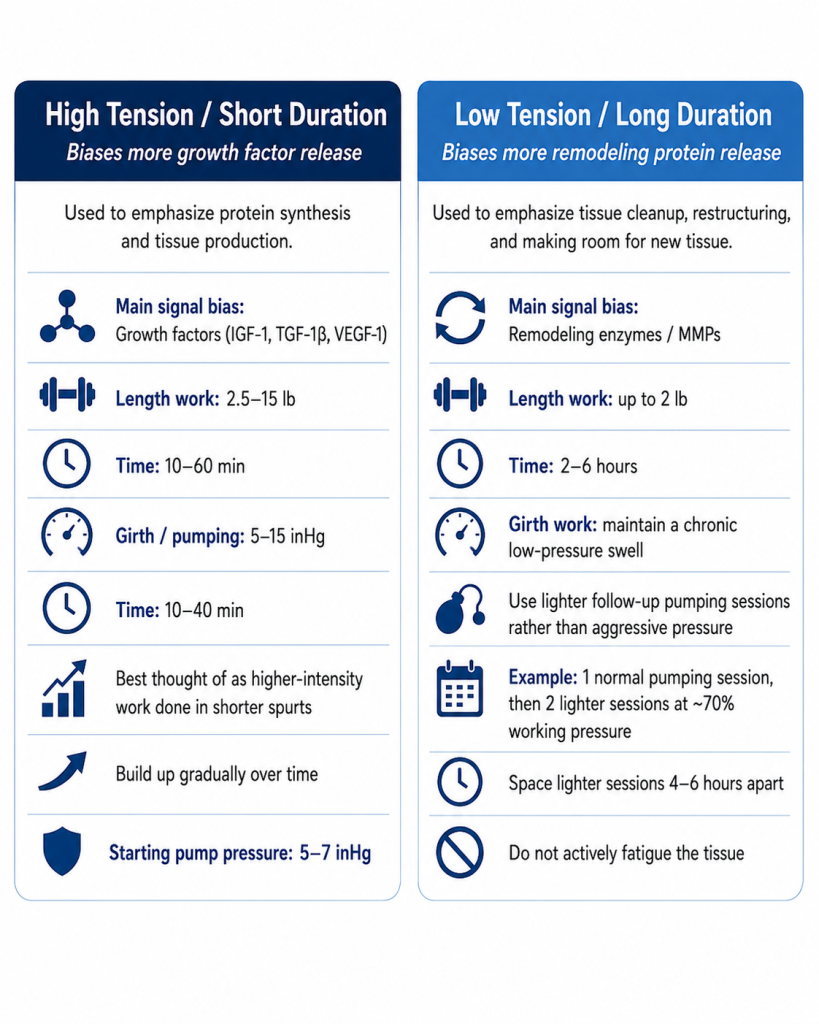
For Growth Factor Release: High Tension in Short Spurts
The short loading time is 20 to 60 minutes, depending on overall load. The problem with this is that it is hard to gauge what exactly counts as high tension.
High tension, in physiotherapy terms, begins to cause mechanical fatigue in the tissues. The collagen protein is physically pulled apart and unfolded. A separate post will go into detail on this.
Most men would see tissue degradation start at as low as 2.5 lb, or about 1 kg, of tension. But this would require a decent amount of time under tension, as the penis adapts to the load over time.
Many guys will need to increase up to 15 lb over the course of their PE career. But there is no hard limit on what high tension is. I know men who have gotten up to 40 lb of tension, which is probably overkill in most scenarios.
My general model has high tension, from 2.5 lb to 15 lb of tension, as the effective, safe working range of weight for elongation.
For Girth: The Same Idea, but Measured Differently
For girth, it is the same idea, except we normally measure tension as vacuum pressure. This has become a subject for debate this last year: what is optimal?
Some individuals believe that the optimal pressure for pumping should be about 12 inches of mercury. I think we should not deal with absolute recommendations because there is such a huge variance in humans. As only the Sith deal in absolutes.
But something that goes overlooked in his recommendation is that you need to work up to that pressure over the course of months. You do not just start on your first day at the gym and try to bench 225. The same idea applies to PE.
Safe Starting Pressure
A safe starting range for pressure is going to be 5 to 7 inches of mercury. Remember, pressure is additive to your current erection pressure. So if your erection exerts 5 inHg of pressure, and you pump with a vacuum of -5 inHg, you are actually exerting 10 inHg onto the penis. That is double its normal working pressure.
The safe working range for pressure is 5 to 15 inches of mercury. Anything beyond 15 inHg is excessively dangerous to the nerves and skin of your penis.
For More Remodeling Protein Release: Low Tension for Long Periods
For length, this is straightforward. Anything below 2 lb for 2 to 6 hours. Going beyond 6 hours can limit growth factor uptake and hurt gains. Low tension is probably going to depend on how big you are. I do not have hard numbers on this at the moment.
For Girth: Low Tension Gets More Complicated
For girth, this is where it gets complicated because we do not have a particularly safe way to cause chronic dilation that does not increase the risk of lymphatic issues or discoloration.
The safest way to pull off chronic low tension is to pump up often at lower pressures than your normal working pressure. The chronic swell will cause low chronic tension to the tunica, leading to more shape-change protein release.
My Current Recommendation
My current recommendation is one heavy pumping session with your normal working pressure for 10 to 20 minutes. Then follow that with 2 lighter sessions at 70% of your working pressure.
We are just trying to keep the existing swell for an extended period. Do not actively fatigue the tissue. Space these lighter sessions 4 to 6 hours apart.
Optional Cockring Use
For those who do not mind a bit of risk, wearing a cockring for 10 to 20 minutes after every pumping session seems to really keep the shape from the pump for an extended period. My best guess is that the tunica relaxes in this new, larger shape, so it does not actively push out swelling.
Be warned: the cockring will increase the rate of discoloration and opens up the chance of lymphatic clogging and lymphocele. Lymphoceles are nuisance injuries. They are not debilitating at first, but if constantly aggravated, they can become a more severe issue. Mainly, they are an aesthetic issue to start.
The Gist
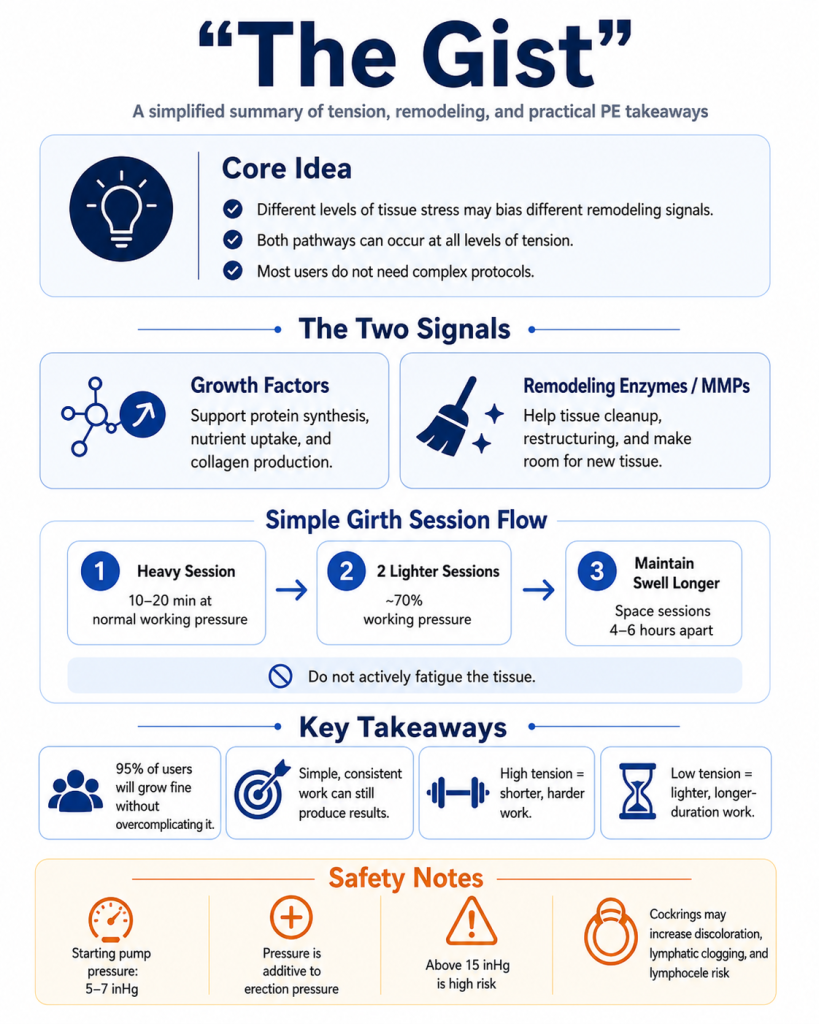
We have two different types of hormone release we need to consider. But it is overkill for PE. 95% of you will grow just fine without this level of complexity.
- High-tension routines cause more growth factor release than remodeling release.
- High tension starts at 2.5 lb and can go up to 15 lb for periods of 10 to 60 minutes.
- High pressure starts at 5 inHg and can go up to 15 inHg for periods of 10 to 40 minutes.
- Low-tension sessions cause more remodeling protein release than growth factor release.
- Low tension is up to 2 lb of tension, probably dependent on size, for 2 to 6 hours.
- Low pressure is hard to gauge safely, but keeping a chronic swell with pumping will keep minor pressure on the tunica for an extended period of time.
- A cockring can be considered after a pumping session, but due to its potential risks, use caution before adding it to your protocols.