

We get a lot of questions about combining length and girth work, knowing when pumping pressure is too high, managing pelvic floor fatigue, and deciding when a routine needs more intensity or simply more recovery. This Q&A pulls together the most useful answers to those questions, with an emphasis on building a routine that creates enough stimulus to progress without repeatedly beating up the same tissue.
Should You Combine High-Tension Extending With an All-Day Stretcher?
Yes, but we would usually use them in the same progression rather than alternating between completely separate high- and low-tension days.
The high-tension session provides the primary length stimulus. Depending on the routine, that may mean roughly 20–40 minutes of focused extending. Afterward, the all-day stretcher can be used at a much lower tension to help hold the tissue in a longer position.
The way we think about it is:
- High tension creates the stronger fatigue and remodeling signal.
- Low tension helps reinforce the position created by that session.
- Recovery determines whether the combination remains productive.
That makes the two methods complementary. There usually is not much reason to treat them as competing forms of training unless total workload is becoming difficult to recover from.
More work is not automatically more growth. The goal is to use the low-tension device to support the high-tension session not to turn the entire day into one continuous max-effort workout.
Should You Keep Increasing Pump Pressure After You Reach Maximum Expansion?
No. Once you reach strong expansion and begin feeling an actual ache or pain, that is generally a sign to stop increasing pressure.
There is an important difference between productive tissue tension and simply forcing more vacuum into the cylinder. If the tissue has already expanded as far as it reasonably can during that session, additional pressure may increase skin stress, edema, broken capillaries, and irritation without meaningfully increasing the stimulus to the deeper erectile tissue.
One complication is that the fat pad can make your in-cylinder length appear greater than the amount of actual shaft expansion. That can tempt people to keep chasing a visual number even though the underlying tissue has already reached its useful limit.
The practical answer is to pay attention to what the tissue is telling you:
- Mild tension may be expected.
- A developing ache usually means you have reached the useful stopping point.
- Sharp pain is not a progression target.
- If you feel almost nothing, do not assume that means you need dramatically more pressure.
The “not feeling anything” situation can actually be more dangerous because it encourages people to use higher and higher pressures in search of a sensation.
Why Is Too Much Edema a Problem During Pumping?
Some temporary fluid movement is difficult to avoid, but excessive edema can interfere with the type of expansion we are actually trying to train.
Edema is fluid collecting under and within the tissue. When too much fluid accumulates, it can create the appearance of a much larger post-session measurement without representing useful erectile-tissue expansion.
Too much edema may also compress the deeper structures and make it harder to continue filling the corpora cavernosa effectively. At that point, you may be enlarging the skin and superficial fluid layer more than you are training the blood-holding tissue.
Our general guideline is that post-pump girth should not repeatedly exceed roughly 8–10% above baseline. That is not an absolute rule for every individual, but it is a useful warning line.
The main thing to understand is that edema is not free growth. It can make a session look productive while reducing the quality of the underlying stimulus.
A good pumping session should create controlled expansion, not turn the shaft into a water balloon.
Can You Train Length and Girth at the Same Time?
Yes, but we would not normally divide the routine into a perfect 50/50 split.
Most productive routines have a clear primary focus. If length is the priority, the majority of the workload should come from extending, hanging, or manual length work, followed by a smaller amount of pumping.
A rough example would be:
- Around 80% length-focused work
- Around 20% pumping or expansion work
The pump work can support erection quality, endothelial development, and blood-vessel adaptation while the length work remains the dominant signal.
A girth-focused phase may be structured differently. Instead of performing a large volume of traditional length work, we may use massage and other mechanical work intended to reduce resistance to circumferential expansion.
Trying to push maximum length and maximum girth volume simultaneously can create conflicting demands and an unnecessarily large recovery burden. You may still progress, but the results can become slow enough that they are difficult to distinguish from ordinary measurement variation.
Pick a direction, keep a smaller amount of supporting work, and let the routine communicate a clear priority.
Why Do PE Gains Usually Slow Down as You Get Bigger?
Progress slows partly because a larger erection places greater demands on the systems responsible for creating and maintaining it.
As total size and volume increase, the pelvic floor has to generate enough force to support that larger structure. The cardiovascular system must deliver enough blood, and erection quality must remain high enough to fully express the additional tissue.
Early gains may therefore feel relatively easy. Filling and supporting the first increase in size does not require the same level of physical performance as supporting several additional inches or a major increase in total volume.
The larger you become, the smaller your margin for error becomes.
Poor sleep, low blood volume, inadequate cardiovascular fitness, pelvic floor dysfunction, stress, and inconsistent erection quality can all hide progress that might otherwise be visible.
We would compare it to moving through increasingly competitive levels of a sport. A beginner can improve while making plenty of mistakes. At an advanced level, small weaknesses matter much more.
Eventually, progress becomes as much about performance and recovery as it is about applying more mechanical tension.
Should You Increase Extender Weight After Reaching 5% Elongation?
No. If you have reached approximately 5% elongation during the session, you have already created a very substantial amount of tissue fatigue.
Collagen tissue has a limited elastic range. Once you move well beyond that range, the risk shifts from controlled fatigue toward microtrauma and eventually more serious injury.
That means 5% should not become the new starting point for another round of heavier loading. It is better treated as a stopping point.
Once you reach the target:
- End or reduce the high-tension work.
- Allow the tissue to recover.
- Consider low-tension retention work afterward.
- Avoid chasing a larger temporary stretch simply because the device can produce it.
The objective is remodeling, not proving how far the tissue can be forced in one session.
More weight is only useful when it helps you reach an appropriate stimulus. Once that stimulus has already been reached, additional weight mainly adds risk.
Can Clamping Contribute to Pelvic Floor Tightness?
Yes. Clamping can create a large pelvic floor demand, particularly when the sessions are long, frequent, or added to an already excessive routine.
A clamp restricts outflow while the erection continues pressing against that restriction. The pelvic floor may continue contracting against an increasingly difficult load, which can leave the surrounding muscles irritated or chronically tense.
Possible signs of pelvic floor strain can include:
- Increased urinary frequency
- A tight or sore perineum
- Difficulty relaxing during erections
- Reduced erection quality
- A feeling of constant tension through the pelvis
- Fatigue that carries into the following day
In the example discussed, three 10-minute clamping sets were being combined with relatively little pumping. We would reverse that emphasis.
Pump first to create controlled expansion, then use a shorter clamping set as a finisher if the tissue and pelvic floor tolerate it.
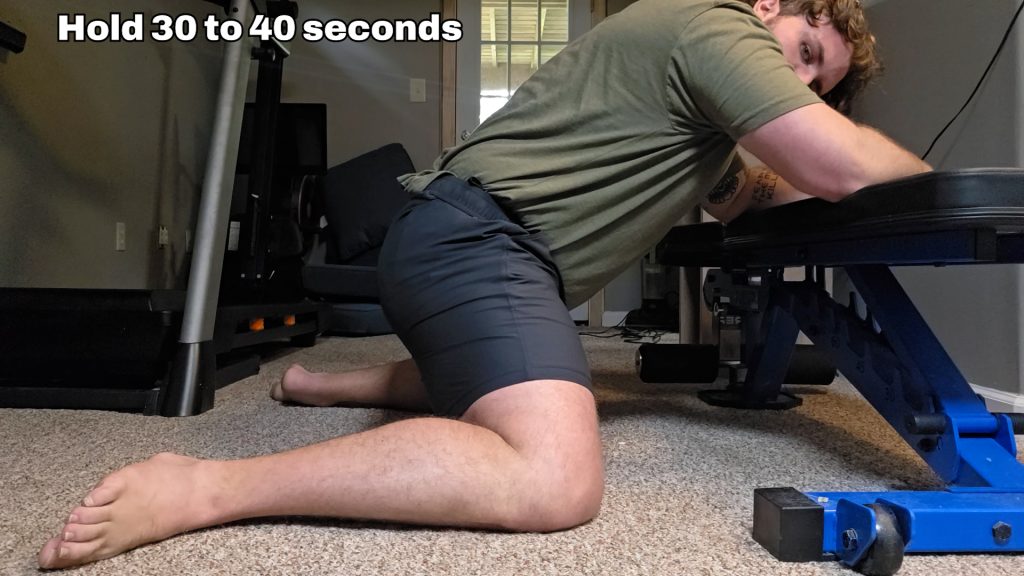
Clamping should not be the foundation of a routine when pelvic floor symptoms are already present. Take the symptoms seriously, reduce the workload, work on hip mobility and pelvic floor release, and rebuild the routine around what you can recover from.
Do All PE Sessions Need to Be Completed Within Six Hours?
No. There is no established rule that all PE work must be completed inside a six-hour window.
That idea appears to have been extrapolated from limited research rather than demonstrated as a universal requirement. The more important variable is whether the routine creates enough cumulative fatigue to stimulate adaptation.
Fatigue does not instantly disappear because several hours passed between two sessions.
However, that does not mean splitting a routine is always better. Performing 45 minutes of extending in the morning, another 45 minutes later, and then adding pumping may create more total work than necessary.
We generally recommend finding the minimum effective workload first. Try the single 45-minute session, track the resulting elongation and recovery, and only add more work when the measurements justify it.
A split routine can be useful when scheduling requires it, but it should not become an excuse to double the workload.
Convenience is a valid reason to split sessions. Fear that the first session “stopped counting” is not.
Biggest Takeaway
The biggest mistake in PE programming is assuming that every plateau requires more pressure, more time, more sets, or more devices.
A productive routine needs enough stress to create adaptation, but it also needs a clear focus and enough recovery for that adaptation to occur.
Use high tension to create a length stimulus, low tension to support the new position, pumping to develop controlled expansion, and clamping sparingly when the pelvic floor can tolerate it.
Track meaningful indicators such as session elongation, erection quality, post-pump expansion, skin condition, and recovery. Do not let temporary swelling or an unusually large measurement trick you into thinking that the most aggressive session was automatically the best one.
The smarter question is not, “How much more can I do?”
It is, “What is the smallest amount of work that keeps producing measurable progress?”