

Progressive overload is still widely used to increase workload for continuous gains. But a lot of people have the wrong idea to begin with.
In this post, we are going to go over what progressive overload actually looks like for penis enlargement, the common traps, and how to do it effectively.
First Pitfall: Not Understanding the Relationship Between Weight and Time
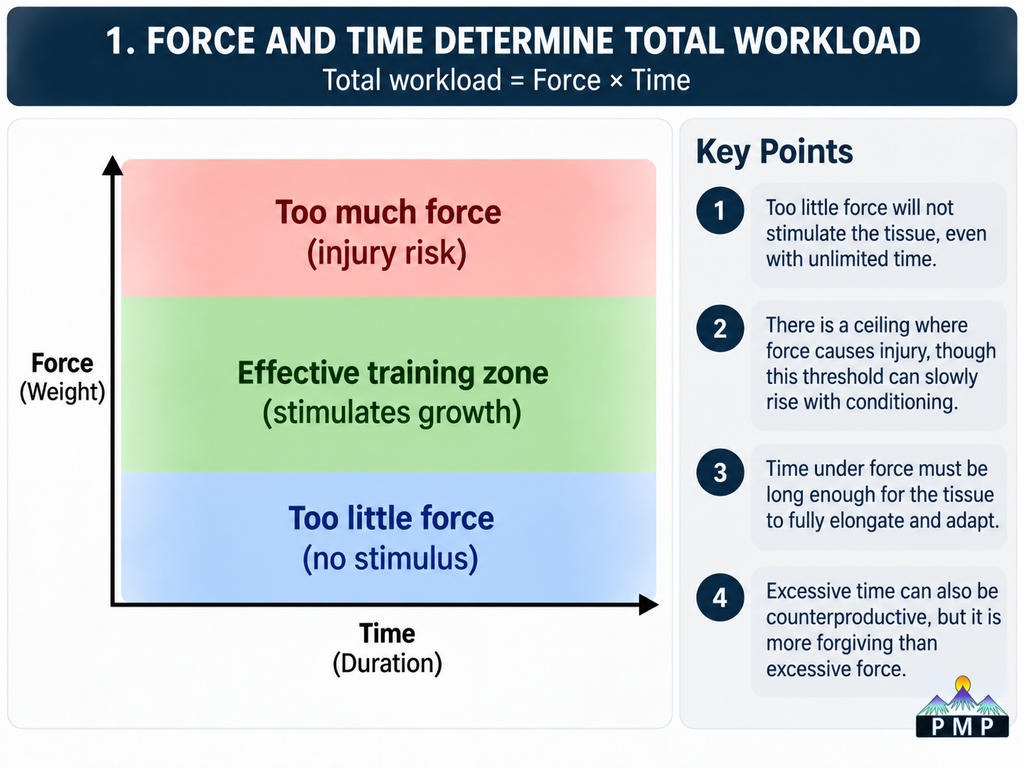
Total workload = force × time.
This means force and time are related. There are two different variables we can control to change overall workload. Theoretically, we can increase these indefinitely, but there are a few practical limits.
- There will be a point where the force is too low to elongate or expand the tunica. At that point, the force is so small that even with unlimited time, the tissue is never stimulated.
- There is a ceiling in force beyond which the tissue is injured. However, with progressive overload, strength adaptation, and conditioning, that ceiling slowly rises.
- The same principle applies to time: time under force must be sufficient to allow the tissue to fully elongate and expand. A microsecond of force is more likely to lead to injury than to produce a useful stimulus.
- Too much time under adequate load causes more degradation. However, excessive time is much more forgiving than excessive force.
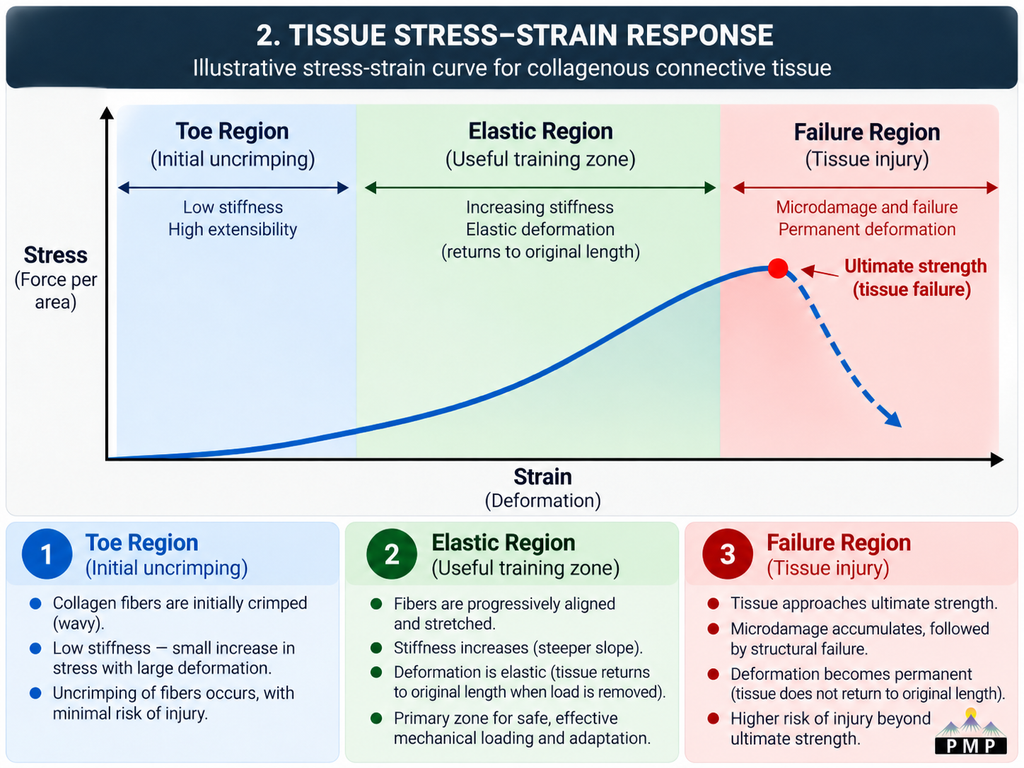
What that means is we need enough weight or pressure, applied for long enough and often enough, to see gains. But because of this relationship and our biological limits, it is easy to overshoot the total workload early.
Second Pitfall: Treating the Penis Like a Muscle
Muscles make for a nice analogy for training, but the penis is not a skeletal muscle. It does not have nearly as strong an adaptation mechanism. It is not designed to hypertrophy, although it can grow new tissue over time. Its recovery rate, rate of gain, and overall stimulus requirements are much lower than those of muscle tissue.
The penis’s shape and size are mostly controlled by the tunica albuginea, which behaves more like a tendon. It is an organized collagen structure with the ability to stretch and deform. Our routines should match tendon physiotherapy more closely than bodybuilding protocols.
An important disclaimer: tendons have some vascularity for nutrient delivery, meaning they can heal faster and have a different fibroblast density, or working cell count, than the penis’s tunica albuginea. This means the penis will still recover more slowly than a tendon and will require less work.
But for the sake of argument, we are going to treat the strength profiles of tendons and the tunica albuginea as equivalent.
In strength sports, stiff tendons translate to more explosive movement. A higher vertical jump, greater power, and faster acceleration all depend partly on tendon stiffness, which allows for a more “violent” release of energy upon muscle activation.
To increase power output beyond muscle strength alone, explosive athletes train their tendons with heavy weights to increase density and, therefore, the overall stiffness of the tendon.
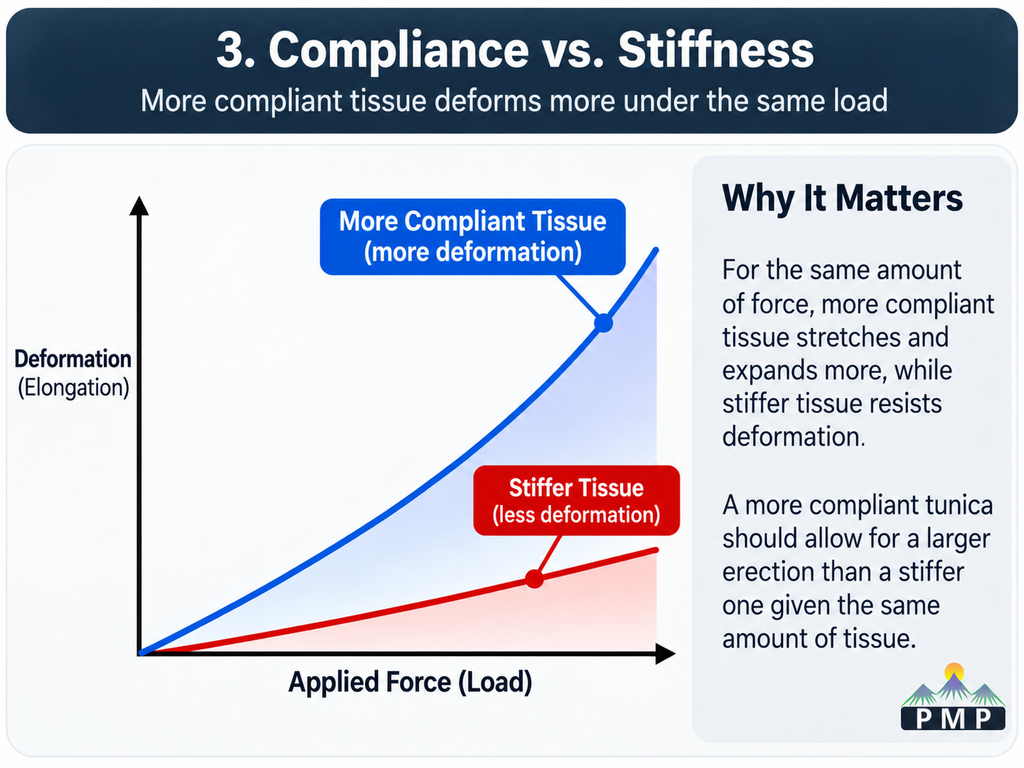
However, for the penis, a stiffer tunica is the opposite of what we want. Erect size depends on how much the tissue can expand as it fills with blood. So, if the tissue is stronger but the amount of blood allowed into the chambers stays the same, a strength-adapted tunica will paradoxically produce a smaller erection than a weaker tunica of the same mass.
If we progressively overload the penis as we would a tendon, we are making it harder to reach maximum size because of the strength adaptation in the tunica.
So, chasing heavy weights and high pressures for PE will have the opposite long-term effect from what we want. We will still see gains, as the added tissue is not limited to tunica thickness but can also contribute to overall surface area. However, once someone plateaus, the added strength from this type of training will make further long-term gains exceptionally difficult.
Returning to the muscle analogy, constant increases in weight can lead to more stiffening effects based on the tendon model. And we want to avoid that long term.
A Compliance-Based Approach to Progressive Overload
What I propose instead is a compliance-based training protocol. Rather than automatically increasing the stimulus, we track the outcome first and only adjust the routine when the tissue response shows that more work is needed.
Compliance-based training aims to keep the tissue as supple and flexible as possible, allowing for maximum expansion across the total surface area of the tunica. Given the same amount of tissue, a more compliant tunica should allow for a larger erection than a stiffer one.
I treat this as a flexibility problem rather than a tear-down-and-rebuild problem.
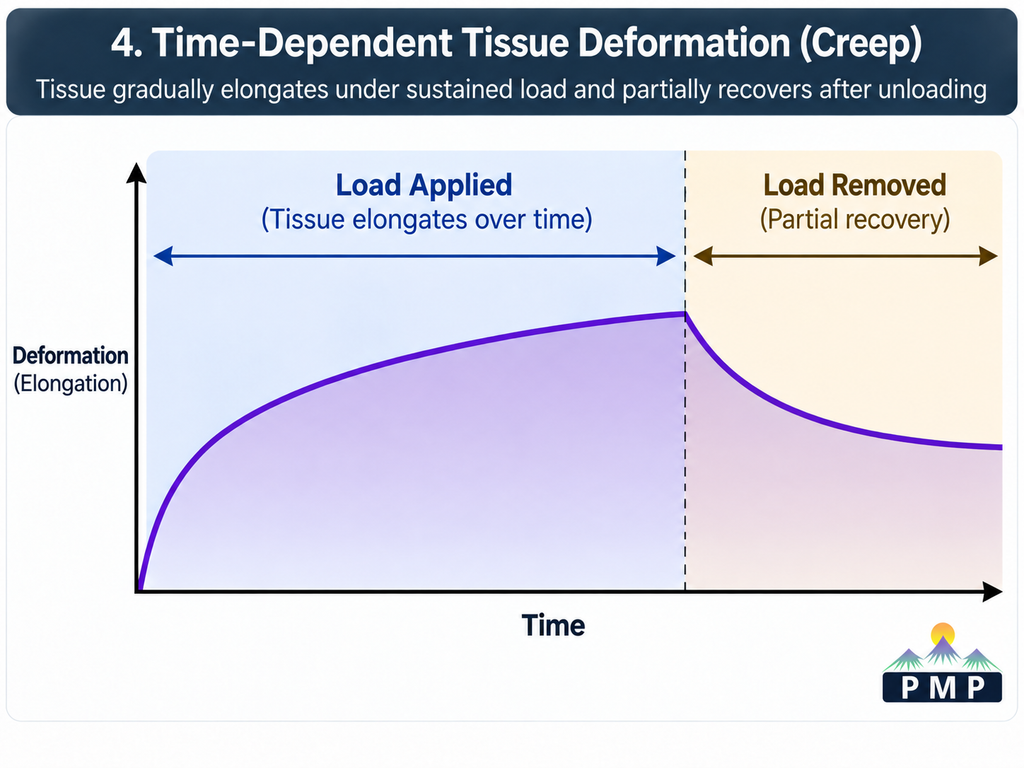
In animal models, cyclical loading has been shown to increase tissue flexibility, reorganize collagen along the direction of stretch, and produce a hypertrophic response that tends to follow the axis of tension.
Heavier loading may cause more tissue accrual, but it may not increase total surface area more effectively than a lower-tension, cyclical loading program.
So, we should not chase numbers, but we should not be overly conservative with stimulus either. We need to find the amount of work that maximizes compliance while still generating a meaningful amount of new tissue.
The goal is a mild increase in collagen density alongside a greater increase in total surface area.
This protocol for progressive overload will be much less aggressive than what you may have seen elsewhere. Unlike other protocols, it respects the limits of your phallus rather than following gym-bro logic: more weight equals more stretching, which equals more growth.
We are going to start from the very beginning, as if your hanger or extender just came in today.
Progressive Overload Protocol
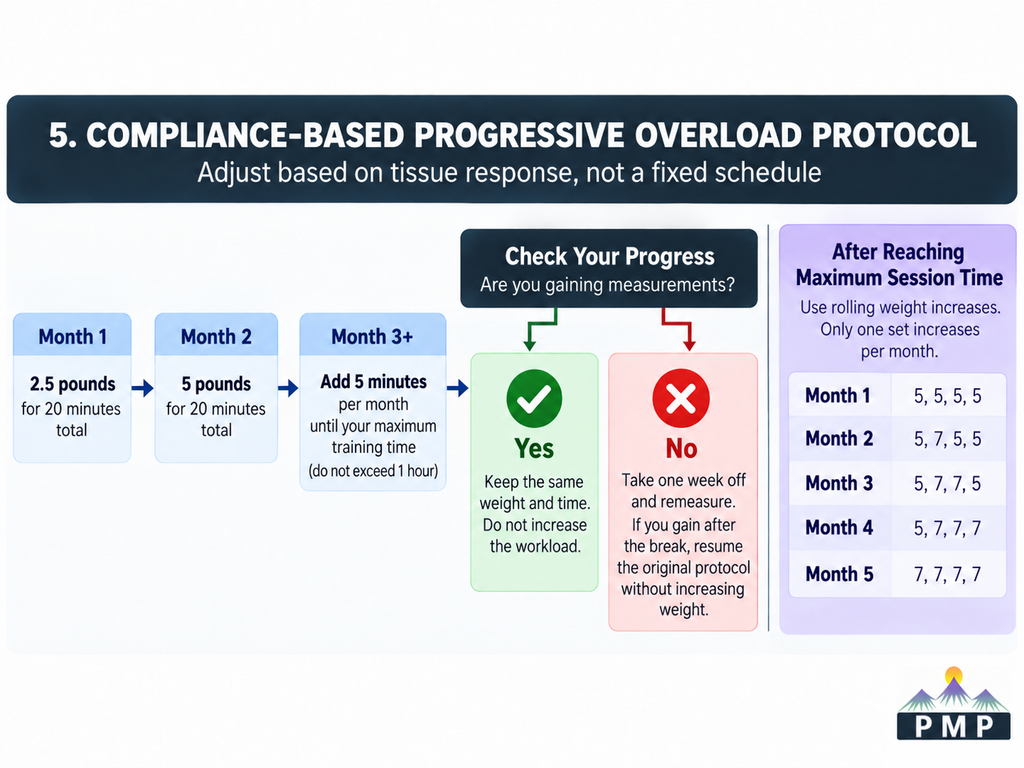
- Month 1: 2.5 pounds for 20 minutes total.
- Month 2: 5 pounds for 20 minutes total.
- After Month 2: Add five minutes per month until you reach your maximum available training time. Do not exceed one hour.
However, there are a few important rules.
Rule 1: If You Are Gaining, Do Not Change Anything
If you are still gaining at 5 pounds for 20 minutes, there is no reason to increase the workload.
Progression should only happen once your current routine stops producing results.
Rule 2: If You Have Not Gained in a Month, Take a Break
If you have not gained in a month, take one week off and then remeasure.
If your measurements increase after the break, cumulative fatigue was likely limiting tissue performance.
Resume the original protocol without increasing the workload.
Rule 3: Once You Reach Your Maximum Session Time, Use Rolling Weight Increases
Increase the weight of only one set per month.
For example:
- Month 1: 5, 5, 5, 5
- Month 2: 5, 7, 5, 5
- Month 3: 5, 7, 7, 5
- Month 4: 5, 7, 7, 7
- Month 5: 7, 7, 7, 7
You can make these increases more gradual, but you must still follow the previous rules before increasing weight.
If increasing weight does not increase your measurements, then a lack of stimulus is probably not the limiting factor.
Logically, something else is more likely limiting tissue performance or recovery.