

Alright guys, we’re going to keep this one relatively simple.
At the end of the day, we’re trying to grow soft tissue. To understand how to do that effectively, it helps to look at how other soft tissues in the body adapt. While the penis isn’t exactly the same as muscle, tendon, or ligament tissue, there are enough similarities that we can borrow some useful principles.
Personally, I tend to pay more attention to tendon and ligament research because those tissues are largely collagen-based, much like the structures we’re trying to influence with PE.
So let’s start with a simple question:
What causes growth to slow down over time?
The Body Doesn’t Like Runaway Growth
Our bodies operate under a principle called homeostasis. In simple terms, the body doesn’t want anything getting too far out of balance.
If a tissue is exposed to a chronic growth signal for long enough, the body begins reducing the strength of that response. Growth is metabolically expensive. Constantly trying to build tissue requires energy and resources, and excessive growth in one area can create problems elsewhere.
To prevent this, the body uses various “limiters” such as receptor downregulation and hormones that counteract other growth-promoting signals. Genetics also plays a role in governing overall sensitivity to stimuli.
We see this throughout physiology.
If these downregulation systems didn’t exist, someone could theoretically continue putting on muscle at an extraordinary rate simply by lifting weights for years on end. Obviously, that doesn’t happen. But the differences between genetic responses are what change outcomes at scale. Everyone can gain muscle. Not everyone will have 18-inch biceps.
The same principle appears in tendons and ligaments. Those tissues adapt and strengthen, but their growth response becomes regulated over time.
If we assume that penile tissue behaves similarly—as a collagen-rich soft tissue—then it makes sense that it may also experience some form of adaptive slowdown during prolonged PE training.
This response is similar to how fast a tendon or ligament heals from a sprain. The main “trait” is collagen fibroblast turnover. The d
What We’re Actually Trying to Grow
One thing that’s important to understand is that we’re not really trying to grow cells.
The penis is composed primarily of proteins and extracellular structures. The cells are essentially the workers. They produce collagen and other proteins that give tissue its structure and mechanical properties.
So when we talk about PE, what we’re really trying to do is stimulate those cells to increase protein production and tissue remodeling.
That’s the entire game.
We want to create an environment that encourages the body to produce more structural proteins than it otherwise would.
What the Research Suggests
When we look at animal models and cell culture research involving chronic exposure to growth factors, we consistently see evidence of receptor downregulation over time.
The numbers vary depending on the model, but reductions in protein transcription signaling of roughly 40–70% after four weeks of continuous stimulation aren’t uncommon.
What does that mean in practical terms?
If we apply a consistent growth stimulus for four straight weeks, by weeks five and six we may be getting substantially less protein transcription from the same amount of work.
In other words, we’re working just as hard, but the tissue may not be responding with the same intensity.
At the same time, tissue remodeling is still occurring in the background. Structural changes and collagen remodeling operate on much longer timelines—often measured in months rather than weeks.
So we have to balance both processes.
Why We Use Four-Week Growth Epochs
Based on the available data and the models we’re working from, it seems reasonable to structure PE around periods of intensive work followed by periods of lighter activity.
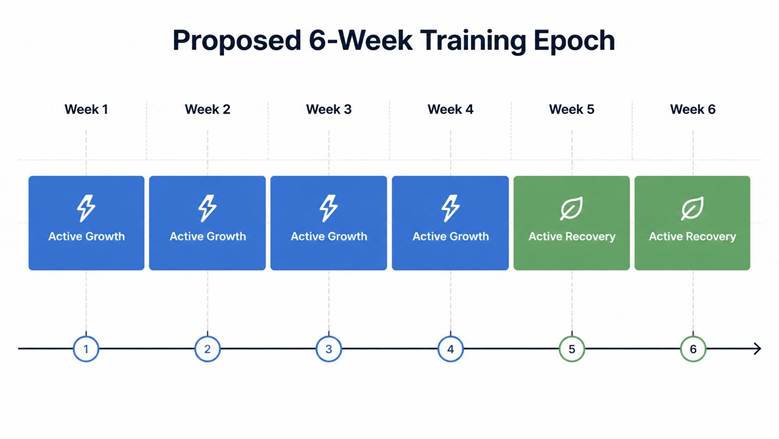
The framework we’ve been experimenting with is:
4 weeks of active training
followed by
2 weeks of active recovery
There are a few reasons for this.
1. It Allows Tissue Recovery
First, it gives tissue time to recover and continue building collagen.
Think of it as allowing the body to work through the backlog of “scheduled repairs” and remodeling tasks that accumulated during the intensive phase.
2. It May Resensitize Growth Signaling
Second, it may allow cellular receptors to become more responsive again.
By reducing the intensity of the growth stimulus while still maintaining some mechanical input, we may be able to regain sensitivity to growth factor signaling before beginning the next intensive cycle.
3. It’s Easier to Adhere To
There’s also a psychological benefit.
Four weeks feels manageable.
Instead of thinking about PE as something we have to do indefinitely, we can focus on reaching the finish line of the current training block.
That makes consistency much easier.
What the Training Split Looks Like
For the active phase, we’re generally aiming for:
4 weeks
5–6 training days per week
The current emphasis looks roughly like this:
- Morning pumping: 10%
- High-tension extending: 65%
- Interval pumping: 10%
- Clamping: 10%
- Evening pumping: 5%
The rationale is fairly straightforward.
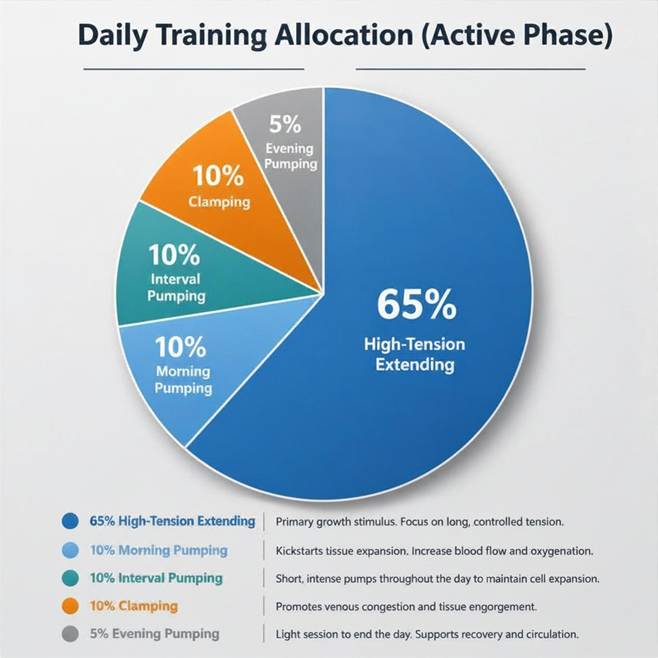
We continue using morning pumping because chronic low-level inflammation appears to be one of the more promising environments for stem cell proliferation and tissue adaptation.
The primary driver remains high-tension extending, which is intended to create the mechanical stimulus that triggers growth factor release.
Interval pumping and clamping can help increase tissue expansion and may be particularly useful for individuals experiencing erection quality issues.
Evening pumping serves as a small supplemental stimulus if time allows.
On a perfect day, that would represent a 100% adherence score.
But let’s be realistic.
B’s and C’s still get degrees.
Getting the primary session completed is vastly more important than chasing perfection.
Something is always better than nothing.
*****I know not everybody can dedicate 6-7 days a week to PE for 4 consistent weeks just given that you guys have a life outside of this and sometimes life doesn’t always allow for it (which can also include the gym), so I encourage you guys to make accommodations, arrangements, or pivots to make it work for you and your schedule, which only changes this approach slightly.
If you train every day, then you can stick to the original proposed approach. However, if you train every other day, then you’re probably looking at a 6-week active phase, but still roughly a two-week active recovery phase. I wouldn’t stray too far from where you’re taking multiple days off and training only 2-3 times a week, because then it gets too complicated of how long these phases are. Like I mentioned before, B’s and C’s still get degrees (or gains in this case) when it comes to PE, so something is always better than nothing.
What Active Recovery Looks Like
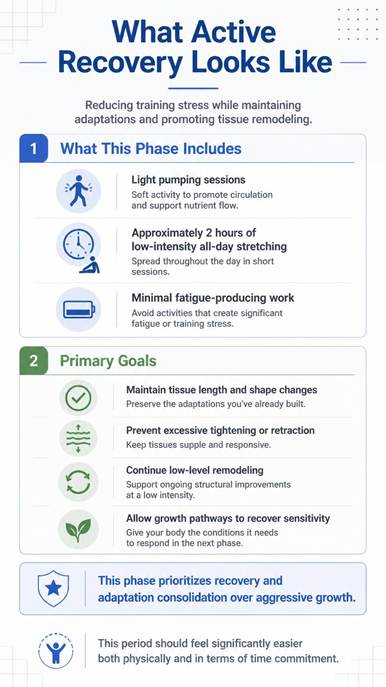
After 28 days of focused work, we transition into two weeks of lighter activity.
This might include:
- Light pumping sessions
- Approximately two hours per day in a low-intensity stretcher
- General maintenance work that doesn’t create significant fatigue
The goal isn’t to stop completely.
We still want to maintain the shape change we’ve been working toward and keep the tissue elongated.
At the same time, we’re reducing overall stress enough that recovery processes can catch up.
The idea is to accumulate as much productive growth signaling as possible during the intensive phase, then use the recovery phase to allow adaptation while potentially restoring responsiveness to future growth signals.
The Bigger Picture
Ultimately, this approach attempts to maximize protein transcription during periods when the body is most responsive while avoiding the problems that come from endless high-intensity training.
We’re trying to encourage growth without drifting into chronic overuse.
Because once we start pushing too hard for too long, that’s when we begin seeing issues like:
- Chronic injuries
- Loss of sensation
- Excessive fatigue
- Poor recovery
- Reduced responsiveness to training
The goal isn’t to force growth.
The goal is to create an environment where growth can occur consistently over time.
If we can average somewhere in the neighborhood of 1/8 inch to 1/4 inch per month without major setbacks, that’s a far more sustainable path than constantly pushing harder and harder.
Final Thoughts
From a physiological perspective, this framework makes a lot of sense.
We’re attempting to maximize tissue signaling, allow recovery, maintain structural adaptation, and avoid the accumulation of chronic damage.
That said, we’re not claiming this is definitively proven.
This is a model built from available research on soft tissue adaptation, collagen biology, growth factor signaling, and tissue remodeling.
It’s an ongoing process, and we’ll continue refining it as we learn more.
But as of now, this appears to be one of the more scientifically grounded ways to approach long-term PE progression.