

I’ll cut straight to it, Pumping… is so damned debated on how to do it right. We have people who say you need 10-second cycles at immense pressure, or 20-minute marathon sets at low pressures… and then you have fools like me, who say, a very broad range of 5-15hg and anywhere from 1-10 minutes on time. Not to mention debates on cylinder size.
But has anyone sat down and thought about what physical tells we can use to ensure we are working the tissue for growth… crazy thought, if we listen to our bodies, we should be able to tell what works for it.
And I’ll be honest; I am a little embarrassed that I did not think of this earlier … it’s that simple.
But before I get into it, guys, I sell penis pumps… There is clear bias here. But who else is better to teach how to use these than the guy who makes a living off of their success?
And just a disclaimer, there is a very high chance this technique has already been “discovered,” so if it’s on a Thunder’s place thread from 2005 on the exact subjects … sorry, but I came to this idea on my own. Two people can have similar thoughts when they are so intuitive.
Let’s first define a good pump.
Condition 1: Maximal engorgement of the blood-holding structures without damaging the structure
This one is straightforward- the time under pressure must be used to dilate the current tissue mass fully. So, we know we need to use pressure above natural erection pressures and a time to fully stretch the endothelial tissue to its maximal volume.
But on the other side of the same coin, too much pressure overstretches the endothelial cells and leads to damage that is… less than ideal for growth.
Condition 2: Optimal fatigue-to-recovery ratio for the tunica albuginea
The tunica is the main rate limiter for growth in PE. It’s the structure that gives the size and shape of the shaft. By nature, it’s very strong for its size, but at the same time, very slow to recover due to it being non-vascular tissue.
So much like the blood-holding tissue, we need adequate pressure to expand fully, but we need the duration and pressure to cause mild over-expansion to cause tissue accrual and shape change.
For recovery. We know we will experience accumulation of fatigue, meaning that the more we pump in succession, the weaker the tissue will become until it reaches terminal loading. Where full engagement with the current tissue mass is at the floor requirements… meaning lower pressure as we do PE in heats… this should also make getting erections easier over time. As the tissue is more compliant to swell
Condition 3: Minimal Edema Swell
I have been on the anti-edema train for years. There are a few ways to build outside the engorgement chambers.
- Negative pressure causing subcutaneous creep of water (the water under your skin is pulled into the vacuum)
- Lymph naturally pools into the lymph channels of the penis. As it has a very weak flow, it does not take much to overcome it
- Fluid leaks from the blood plasma to fill negative pressure gradients at excessive pressure
This is the part I did not know… but if you far exceed how much pressure the tunica can handle… fluid (like water) in your blood can secrete through the blood holding structures, and pool AROUND the vasculature, which actually limits blood holding tissue engorgement as the session progresses. Suppose this effect did not happen. The pressure at 5 in/hg would have the same edema swell rate as 15 in/hg, and anyone who has experimented with pressures has experienced a variance in swelling depending on pressure.
- This effect also happens OUTSIDE the main structures, and this is why the skin can have excessive edema at high pressure
Now we know the win conditions. How do we balance time and pressure? More importantly, how do we make sound decisions on pump pressure for your body… as we should all know by now, two dicks are not alike.
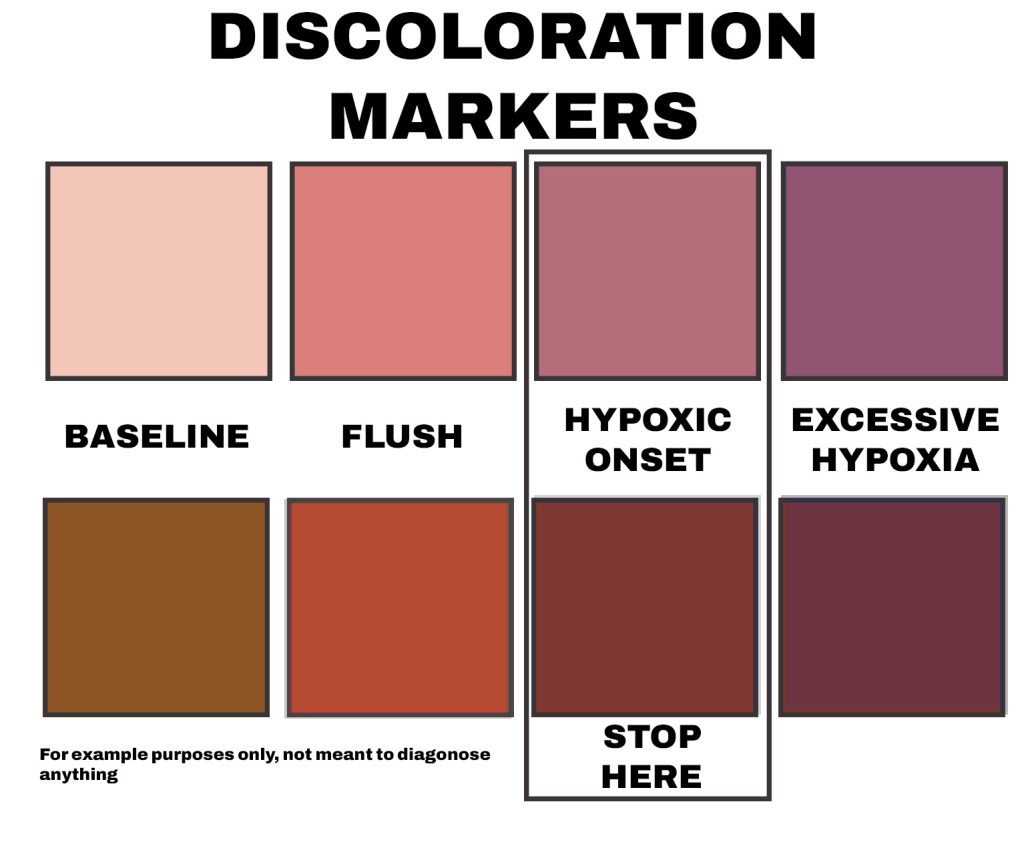
Assumption 1: Skin Color change while under pressure shows the hypoxic limit.
This can be used to determine efficient set times. To be clear, Discoloration can vary widely from dude to dude. There is not a set tone we are looking for, but a specific “gradient change that determines pressure-driven hypoxia.
When we pump the phallus rushes to fill with blood, we should see a significant change in redness to the skin, because it’s flushed. What we are looking for is the point where that red hue turns into a darker hue. The darker hue means the oxygen in the trapped blood is depleting faster than fresh oxygen can be circulated, and we are approaching the point of hypoxia, which is quite stressful, as you can imagine.
The gradient change will be the primary indicator of hypoxia setting in… we are looking for the point where tone is stable. The longer you hold pressure, the darker it becomes, but most of the visible change happens within the first portion of the set once the Penis becomes reasonably dark. It’s time to reset and restore neutral flow.
Most self-experimentation shows this ranges from 1 to 3 minutes for a gradient change. But it’s dependent on pressure and tube size. Too small a cylinder leads to faster occlusion. Too low pressure leads to a lack of occlusion, and too high a pressure leads to premature occlusion
So TLDR for this section: most sets should be about 1-3 minutes. Too low a pressure will show minimal change in skin coloration, while too high a pressure leads to premature discoloration
Assumption 2: The tunica’s pressure tolerance is predetermined by 100% engorgement.
This will have you slapping your head if you’ve been at this for a while. But we have seen many creators assert certain pressures are optimal based on rat studies… but newsflash, you are not a rat.
We already know humans have significant variance in pressure tolerance, blood volume, collagen density, etc., all of which can lead to vastly different pressure requirements.
But the answer is simple. First lets fully understand what the tunica albuginea actually is. In the simplest of terms its pressure vessel that expands and deflates based on internal blood volume. So, there is a point built in for peak fill. Most of us cannot hit peak fill naturally, and that’s why we use a penis pump to get over the hump.
So, imagine going into a pump (or just use one yolo), pay attention to how you expand in the cylinder…. It creeps up quickly until you reach a certain pressure and then snaps to full rigidity with no apparent increase in size. That pressure is the max working pressure for your phallus, as it cannot expand more. It can tolerate more pressure, but it cannot stretch further without fatigue setting in, which is what we want for tissue growth, but we want to limit the negative effects to maximize size results and function long term.
And remember the edema issue… if we go beyond that max working pressure, we will subsequently cause more and more edema as the negative pressure naturally draws fluid into this
So applying this, it is probably the simplest change in your routines. On your first set, enter the cylinder erect, and begin to apply pressure. At a slow, consistent pace. Pay attention as the pressure climbs, the phallus will slowly stop expanding. Once the phallus length stops moving. That’s your target pressure for the rest of the session. On paper, this should be enough to cause fatigue without swelling up edema. But I could see the need to go a little beyond… and when I say a little, that’s 1 in/hg or 3kpa.
Assumption 3: A successful session has apparent markers for multiple days out.
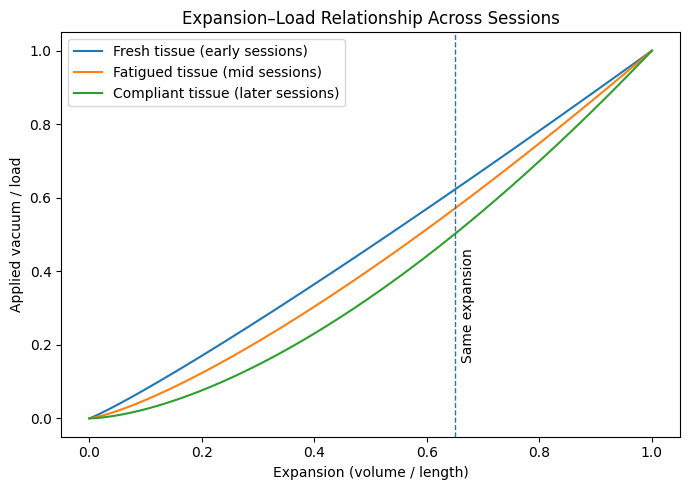
This is one of those neat soft tissue rules I learned that you could see from session to session. Since we now know the working pressure from your last session. If you fatigue the tissue. The pressure requirement for max fill drops. Since the strength of the tunica is now limited due to fatigue buildup. Meaning you need less pressure in the following session to exert the same stimulus for growth.
This effect also stacks. Meaning more sessions you do in succession, the weaker the tunica is, as it still has not fully recovered from the backlog of fatigue. But there will be a point where the maximal fill pressure hits a floor where micro fatigue is practically at its safe limit.
So applying this means EVERY session has its own optimal working pressure. And we need to dial it in every session to maximize performance. When I was playing around this… about 4-5 sessions subsequently led my max fill pressure to drop from 27kpa to 18kpa, which is quite significant…
And honestly, this might be one of the main drivers for improved erection quality is the increase in tissue compliance for max load… You need less pressure to make the largest erection when in a fatigued state. However, overwork…. Whether it be excessive fatigue or loading will lower EQ either on the day or if it’s a loading issue over weeks, if it’s a workload issue.
In Review
The perfect pump is defined by maximum engagement, with adequate fatigue, and with minimal edema. We can assume that skin tone shift can be a marker of set ranges of 1-3 minutes, typically, where shorter than 1 minute is too much pressure and longer than 3 minutes is too low pressure. Actual working pressure is determined by the point of max fill, and not much more is needed (if any). Max fill requirements drop as the fatigue sets from session to session.
This does not change much if you have been following my work for a while… all I did was define working pressure and the need for interval pumping (check it out if you have not.). I will still make follow-up videos Post for routine building, and other things I have learned during my break from social media.