

Since September, I have been looking into diet changes and the effects they can have on overall body performance. Particularly, blood volume and endothelial function… this was to try to maximize Erection Quality and erections BEFORE adding Things like Cialis and nitric oxide boosting supplements
Let me just say it’s quite the rabbit hole. After attempted crucifixion by keto boys for suggesting carbs led to better erectile function ( I am looking at data to make you happy, Keto Clan, so let me cook). I stumbled upon the glory that is sodium.
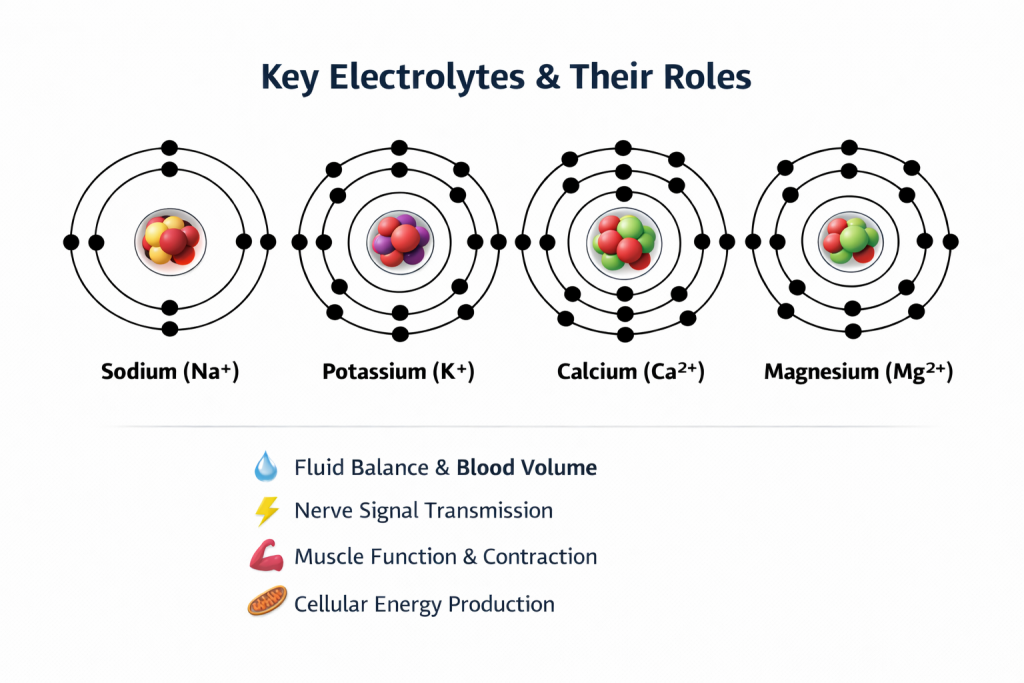
Sodium is oddly demonized in America. This makes it hard to find good data on the subject. But Sodium(and its other electrolytes) are vital to quite frankly all sports performance metrics… which in turn makes it vital for sexual health.
In this (Blog/ Video), I am going to break down how electrolytes are a game-changer for the size and performance of your member.
So, sodium and electrolytes play 2 main roles… Osmotic Balance, and nerve signaling… Osmotic balance is how water is stored in our cells, whether it be in the muscle, under the skin, or in blood plasma. And for nerve performance, electrolytes are what allow for the micro-electric pulses to happen. They will aid in signal strength and clarity when dialed in, but when out of balance or low, the signal weakens, leading to a loss in performance in general.
So let’s break this down a bit.
Osmotic Balance
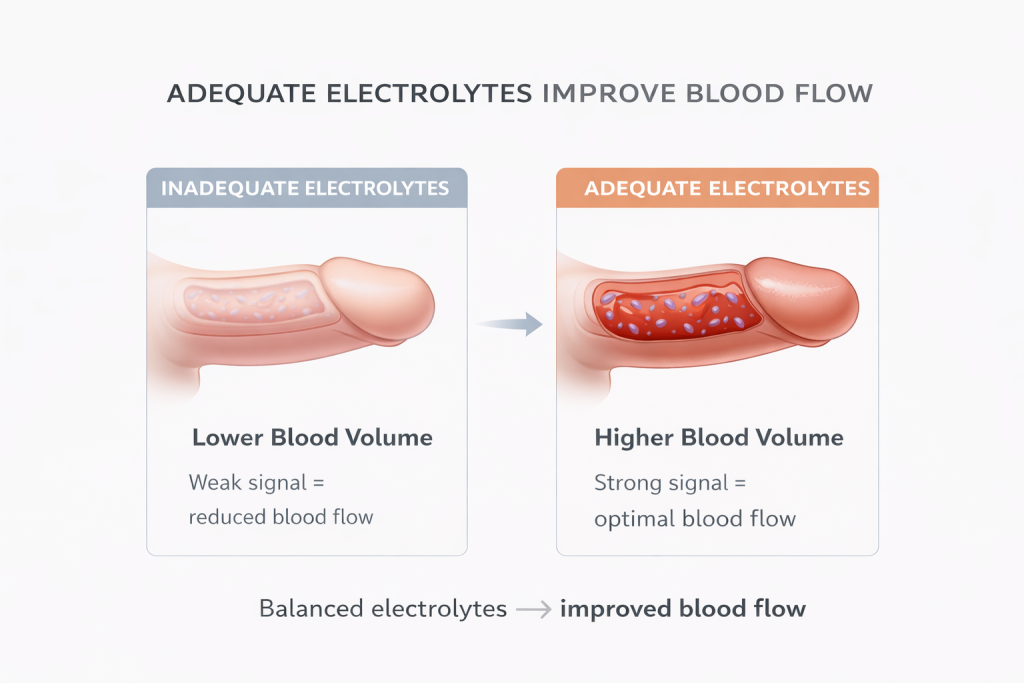
First osmotic balance… let’s just focus on the blood volume for now. Our erections are just a shift in overall blood volume inside the body. When the “flood gates” open, your blood volume redistributes to fill the blood-holding tissue in the penis. Granted, this is marginal milliliters of blood compared to the liters in your system.
So if our blood volume is artificially low, we can potentially see a weaker erection response simply because the tissue does not have enough excess to help pressurize fully, so we get this “good enough” state, but not necessarily optimally full.
When sodium enters the bloodstream ( via digestion), it creates a higher density of dissolved solids… water naturally equalizes, drifting from low particle balance to high particle balances. This is Osmosis. Most of us learned about it in high school, but forgot the mechanism. The issue is this: since the cell membrane is semipermeable, water naturally drifts out of the cells into high-sodium plasma. It could be potentially disastrous for our body to let the cells dump water willy-nilly… so there are mechanisms to dilute the blood plasma… via water retention hormone release (keep the water you have circulating) and increasing thirst. But overall, higher sodium forces higher plasma volume because water needs to be osmotically balanced. So, your body retains more water to make that happen.
The key takeaway… the more sodium you hold, the more water your body has to retain to keep things in balance.
But we really can’t have runaway sodium levels in healthy individuals. It is naturally dumped via urine when you carry it in excess after a while. But the more underrated loss of sodium is sweat. Sweat is derived from your blood plasma, which carries the sodium out with it… so if you sweat a lot, solely drink water to rehydrate, you are leaving yourself sodium (and other electrolytes) depleted. And the loss of sodium is largely based on overall sweat volume. So, to keep in balance, and keep plasma volume high, you will need to replace sodium at the same clip you replace water.
So, to think this out, put this in a working range for you, feeling like death, low sodium levels, to swinging to the max tolerance of a typical man. There is about a 6-7% increase in overall blood volume. This is with average muscle mass… larger men with more muscle, taller, will see an even larger total blood volume increase.
Now I am not expecting most of you to have just run a marathon, nor am I expecting to salt load 24/7 for one. So we could assume that most of you will see 3-4% variance in day-to-day sodium-induced blood volume fluctuations.
Now for erections… what you came for. The simple conclusion is that we can see a 3-4% variance in erection quality just from sodium levels alone. But sodium has more than just one effect on the body.
Nerve Function – How it impacts Erections
As stated, a bit of sodium and its corresponding electrolytes, Potassium, chloride, and magnesium, are vital for nerve function. Since these minerals carry a light electric charge, sodium and potassium carry a positive charge, while Chloride is negative. It creates the conductive properties necessary for bioelectric impulses to transfer. Your nerves sit negatively charged at rest, from a heavy ratio of positively charged minerals surrounding them. This creates a natural drift of potassium outside of the nerve cell to even the electrochemical gradient. leading to a negative charge. Upon activation, a chain reaction cascades, causing a rapid switch to positive, sending the electrical impulse down the nervous system.
If our electrolytes are out of balance, or just low in general. We will see a harder time controlling electrical impulses… whether they be weak… or too strong, leading to cramps. Additionally, supporting electrolytes like magnesium and chloride support “signal clarity,” allowing for a stronger signal without potential interference and misfiring.
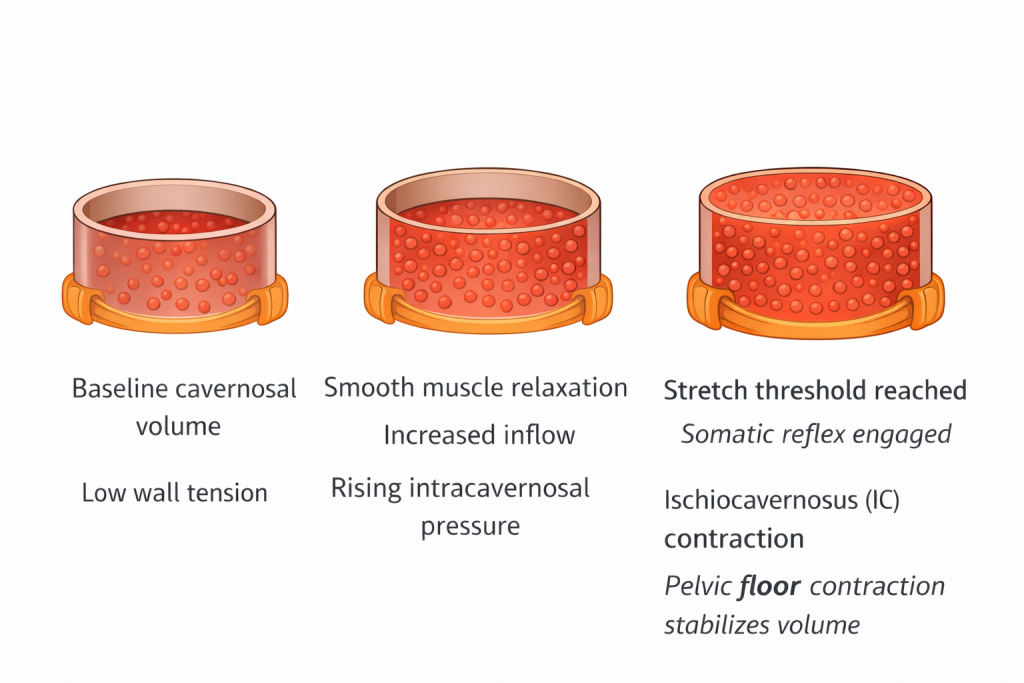
Now, proper nerve firing is clearly vital for all bodily functions. But for erections, it’s two-fold. We have two nerve signals we are dealing with. And poetically, they signal opposites. Arousal signaling (what allows blood into the penis) requires relaxation of the smooth muscle. Then the outflow of blood from the phallus is restricted by the contraction of the pelvic floor muscles. Both responses rely heavily on constant nerve signaling to keep the responses for the entirety of the arousal period.
So if our nerve signaling is weak, or easily interrupted from lack of electrolytes (any or all), we can see sub-optimal erection responses regardless of how much you train your pelvic floor, how strong your heart is, or your total blood volume.
Supplementation Guidelines
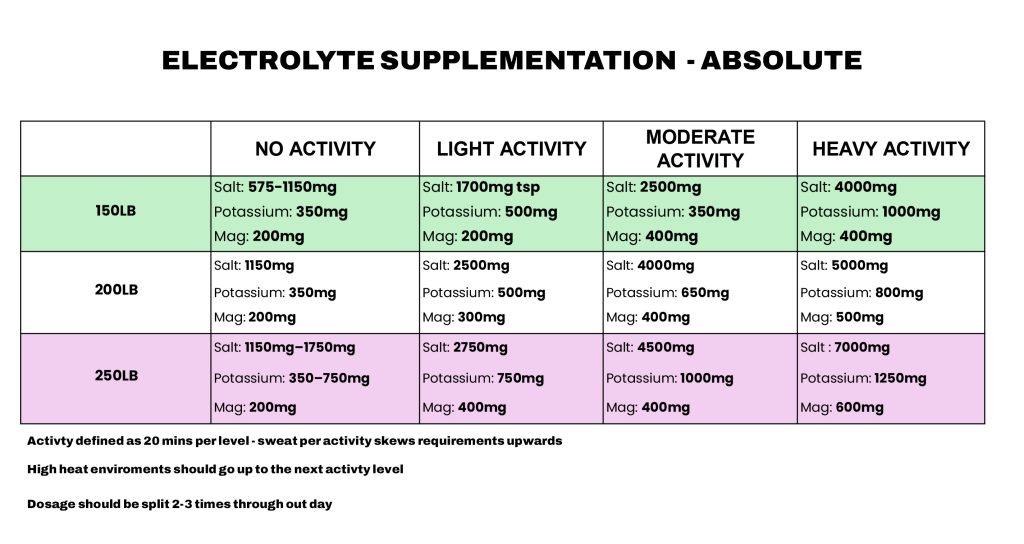
In my opinion, this is the first thing you want to dial in before adding cardiovascular supplementation. Because proper electrolyte balance will lead to your supplements having a better effect… simply because the bottle neck was removed from the system
Now, how do we actually dose these… because I introduced 4 nutrients you need to keep track of now… It’s simple… for me at least.
Sodium and Chloride are probably already in your house…. Table salt is Sodium chloride. You probably have been “supplementing” it unknowingly your entire life… when you crave salty foods… and are a relatively active individual, your craving signaling does a good enough job keeping up with your sodium requirements. But if you are super sweater like myself, you go through salt at a much faster clip. So it might be a good idea to dose some around your workouts… we will talk more specifics at the end.
Potassium is a bit harder to come by; most people get theirs from spinach or bananas( beans and meats as well), but if you are active, it can be relatively easy not to get enough potassium long term. What I do is use a table salt replacement, “lo-salt” or “no-salt”. A lot of supermarkets have them, but so does Amazon… It’s very easy to find.
Magnesium is probably the most difficult electrolyte to source strictly from the diet. It is also found in leafy greens, nuts, and grains. Food processing and soil quality can strip magnesium density from food. This is the only one I would recommend supplementing outright because it also aids sleep.
The good news is it’s damn cheap. I can get 135 servings of magnesium glycinate for 20 bucks, that’s over 2 months’ worth of your daily value.
So, Table Salt … a few dollars, low salt, less than 10. And magnesium glycinate is $20 for 2 months, let’s call it 40 dollars for a 2-month supply of all your electrolytes. It’s hard to find a better ROI for overall performance
Now, where it gets a bit difficult… to at least teach this… is that your intake of all 4 is widely dependent on Body mass, sweat propensity, and dietary conditions.
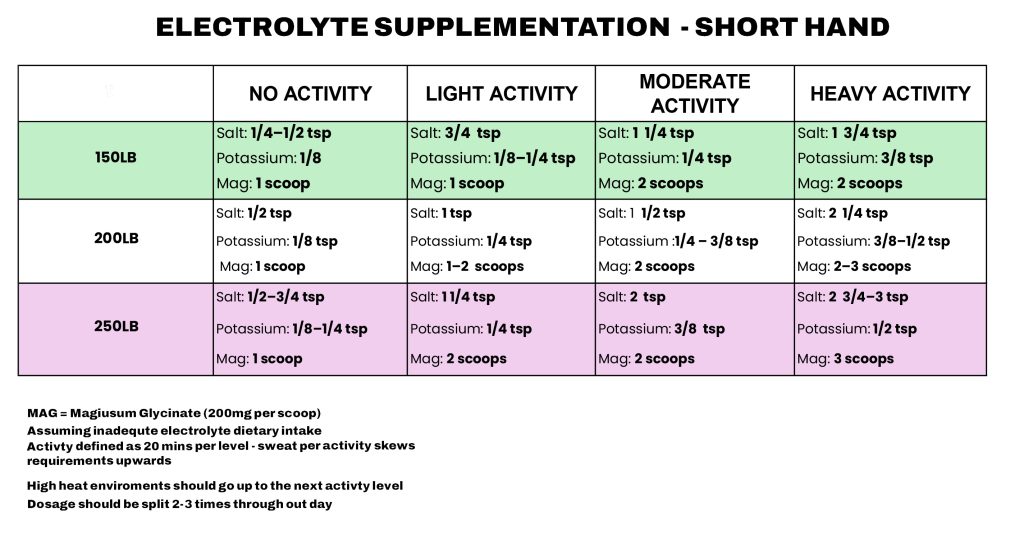
I would recommend taking salt, potassium, and magnesium pre-workout. If you don’t train… your needs are wildly different than mine. So please do not copy me 1:1 in general. There will be a table at the end to help you dial it in. Additionally, if you have any dietary or cardiac or kidney issues… talk to your doctor before you pound salts like me
Magnesium, just one scoop of mag Glycinate. I take 1 teaspoon of table salt with ½ teaspoon of potassium.
Additionally, it might be a good idea to spike your intra-workout drink with salt and potassium. I put the same amount in my protein shake… but I am a large guy… You probably don’t need to match me 1:1
Before bed, I would also dose ½ of what you dose your salt and potassium before your workout, you sweat in your sleep more than you realize. This will help you remain in balance. I would also take another 200 mg of magnesium glycinate to help with relaxation and getting a good night’s sleep.
If it was not obvious, I recommend drinking a ton of water. I literally drink 3-4 liters of fluid from waking up to the end of my workout. Again, this is person-dependent. I will make a chart with general guidelines and share it in the blog.
So, in these charts. I chose higher ranges. Your body will self-regulate sodium retention after 1-2 weeks, but for example, 250lb at heavy activity is 7000mg of sodium throughout the day… yes, this is very high, but only 1% of you will need that much sodium. Sweat scales exponentially with skin and time under exertion, so large men sweat more per capita.
Also included is shorthand, measurements so teaspoons… this is assuming you get no salt in your meals… think of it as your total sodium allowance when cooking… I find this useful when I am spiking my protein shakes, for example.
Electrolyte balancing takes less than a day to notice… It’s a chemistry issue, not a particular ailment… so wants the total dissolved solids in your blood stream reaches optimal levels… your body will hold more fluid, making the system more efficient in total.
The other thing that will be noticeable is water retention… a little bit of skin puffiness… this happens as your body (particularly your kidneys) upregulate for excess salt, and the new water requirements work their way into the tissues. So, it pools in low resistance areas like fascia and under the skin. It should subside in a week; if it does not, I would dial back on the sodium intake.