

Pumping is probably the most popular PE technique, and for good reason. It is simple, easy to understand, and you can feel the difference immediately.
But that is also why a lot of guys screw it up.
They think pumping is just:
“Get in the tube. Pull as much pressure as possible. Stay there. Hope girth appears.”
That is not really training. That is just trying to survive a vacuum chamber with your dick.
A better way to look at pumping is this:
Different pumping styles create different tissue responses.
Interval pumping is not the same as traditional pumping. Traditional pumping is not the same as a quick feeder set. And if you understand the difference, you can build a routine that actually makes sense instead of just stacking random sets until your skin looks like it lost a fight with a jellyfish.
This post is going to cover the difference between interval pumping, traditional pumping, and how to combine them into a full girth-focused routine.
The base concepts here come from the pumping basics framework: air and water pumping both create vacuum expansion, but pressure, set length, breaks, and cylinder sizing all change the training effect. A good air pump should have a pressure gauge, and most men should start with a cylinder roughly 10–15% larger than their current erect girth converted to diameter.
Our sizing calculator
The Main Difference
There are two main pumping styles I use:
Interval pumping
CLEAR NSFW Demo here
Short sets, repeated back to back, usually without coming out of the tube.
Traditional pumping
Longer sets, with breaks between sets, usually coming out of the tube and getting erect again before the next round.
Both can work.
They just do different things.
Interval pumping is better for repeated tissue loading and fatigue. Traditional pumping is better for longer dilation, swelling, and shape training.
That is the simplest way to think about it.
What Is Interval Pumping?
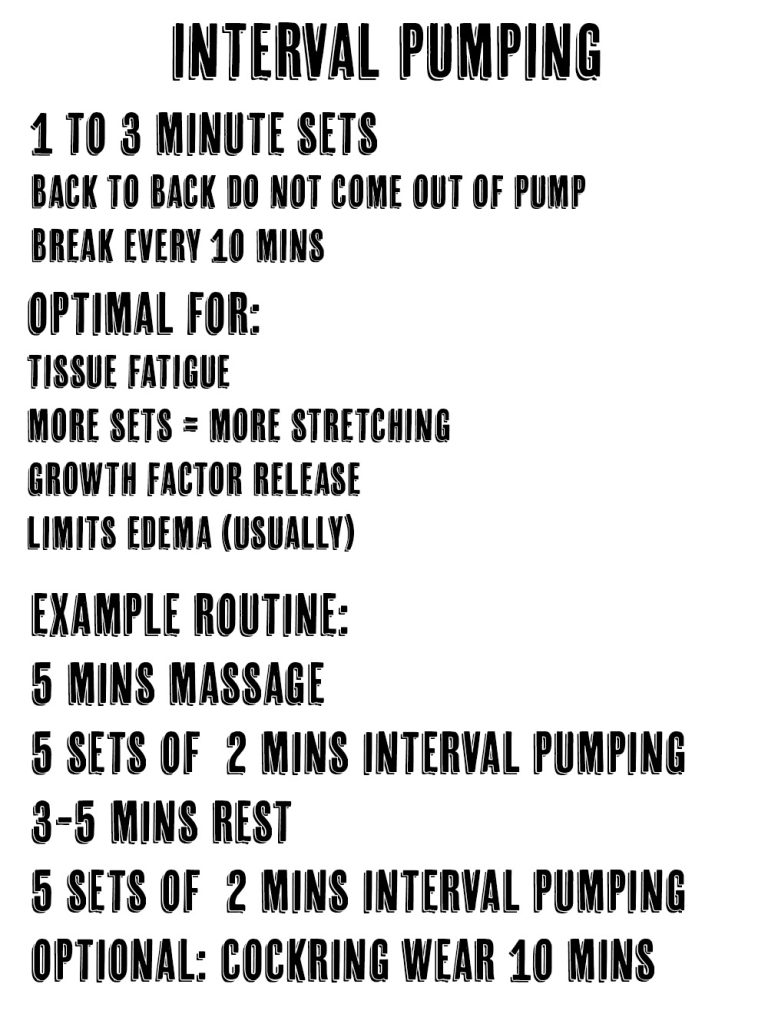
Interval pumping uses short sets, usually around 1–3 minutes per set.
You do not need to come out of the tube between every set. You can simply drop pressure, let the tissue relax briefly, then build pressure again.
A basic interval setup looks like this:
Example interval routine:
5 minutes massage
5 sets of 2-minute interval pumping
3–5 minutes rest
5 more sets of 2-minute interval pumping
Optional: 10 minutes cock ring wear
The point is not just to sit at pressure forever.
The point is the repeated loading.
Load. Relax. Load. Relax. Load again.
That repeated stretch is the whole reason intervals are useful.
Why Interval Pumping Works
Interval pumping is built around repeated expansion.
Soft tissues do not only respond to how long they are stretched. They also respond to how often they are loaded.
So instead of doing one long set and just sitting there, interval pumping gives the tissue multiple rounds of expansion.
That usually makes it better for:
Tissue fatigue
Repeated stretching
Growth factor release
Limiting edema, usually
Better targeting of the blood-holding tissue
This is why I like intervals for guys who are trying to build a better long-term girth foundation.
It is less about looking massive for 30 minutes after the session and more about creating repeated expansion stress.
That does not mean you need to do stupidly short sets.
Some guys try to turn interval pumping into 10-second mini reps. I do not love that for most people. At some point, the tissue needs time under pressure to actually expand.
For most guys, 1–3 minute sets make a lot more sense.
What Is Traditional Pumping?
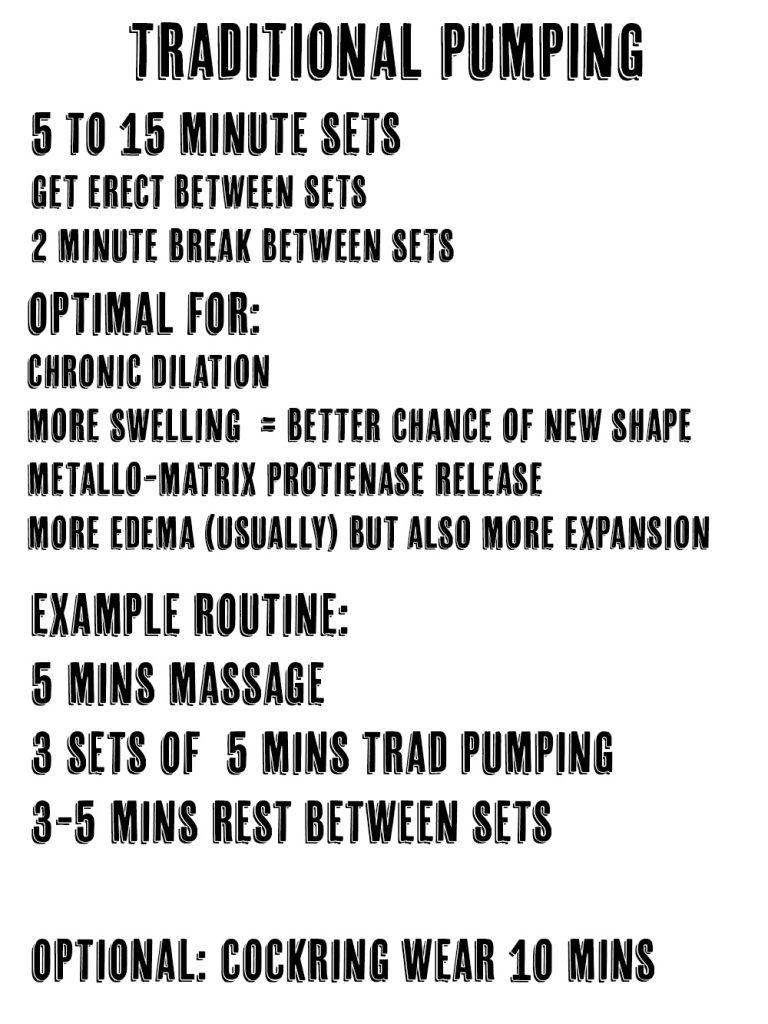
Traditional pumping uses longer sets, usually 5–15 minutes per set.
Unlike interval pumping, you usually come out of the tube between sets, get erect again, let blood flow normalize, then go back in.
A basic traditional routine looks like this:
Example traditional routine:
5 minutes massage
3 sets of 5-minute traditional pumping
3–5 minutes rest between sets
Optional: 10 minutes cock ring wear
Traditional pumping is more about sustained dilation.
You are trying to hold the tissue in an expanded state long enough to encourage more chronic swelling and shape change over time.
Why Traditional Pumping Works
Traditional pumping tends to create more fluid accumulation.
That sounds bad, but it depends on the goal.
If you are only creating sloppy skin edema, that is not ideal. But if you are using traditional pumping intelligently, the longer sets can help train the tissue to tolerate and hold a more expanded shape.
Traditional pumping is usually better for:
Chronic dilation
Shape training
More swelling
Longer expansion exposure
Potential metalloproteinase release
Teaching the tissue to live in a bigger state
The downside is that traditional pumping is also more likely to create edema.
That is why I usually recommend breaking longer sessions up instead of just camping in the tube forever.
For most guys, I would rather see 5–10 minute sets done well than one brutal 25-minute set where the skin taps out halfway through.
Interval Pumping vs Traditional Pumping
Here is the clean version.
Interval Pumping
Best for repeated tissue fatigue.
Usually:
1–3 minute sets
Back-to-back sets
No need to come out of the pump every set
Break around every 10 minutes
Usually less edema
Better for repeated stretching and tissue loading
Use this when your goal is more training stimulus with less sloppy swelling.
Traditional Pumping
Best for chronic dilation and shape work.
Usually:
5–15 minute sets
Come out between sets
Get erect between sets
Take breaks between sets
Usually more edema
Better for longer expansion exposure
Use this when your goal is more swelling, more shape training, and longer dilation.
The Best Routine Uses Both
This is where most guys get it wrong.
They try to pick one style forever.
That is too narrow.
Interval pumping and traditional pumping are not enemies. They are tools.
Intervals are great for repeated tissue loading. Traditional pumping is great for longer dilation and shape change.
So the better question is not:
“Which one is better?”
The better question is:
“How do I combine them without overdoing it?”
Because yes, you can absolutely overdo pumping.
Your dick is not a loyalty card where every 10th set gives you a free inch.
At some point, more work just becomes more irritation.
BD’s Perfect Girth Day
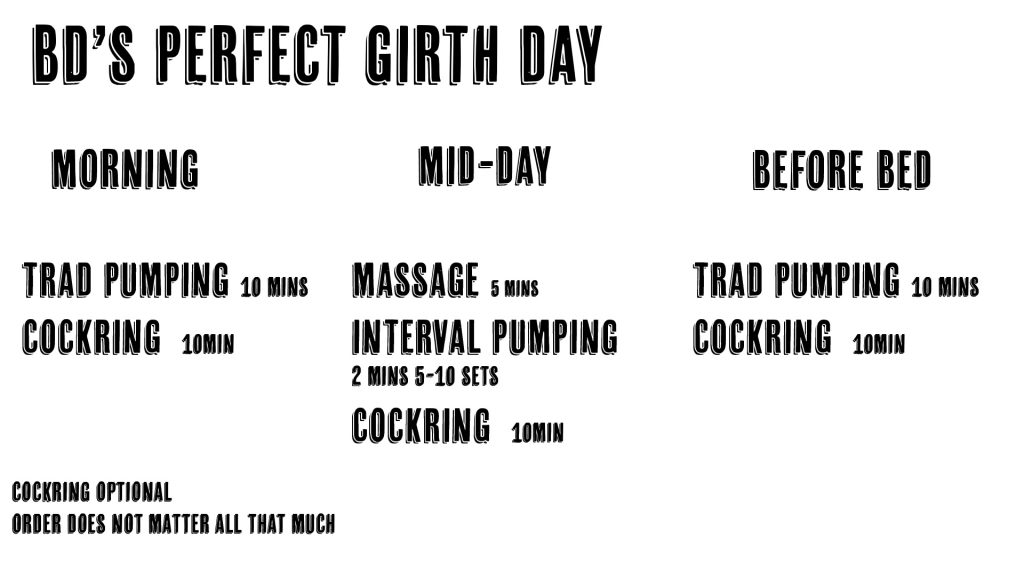
If you want to spread the work out through the day, this is the better version.
The advantage is that you keep the tissue expanded more often instead of doing one giant session and then letting everything fully deflate.
Morning
Traditional pumping — 10 minutes
Cock ring — 10 minutes
Mid-Day
Massage — 5 minutes
Interval pumping — 2-minute sets, 5–10 sets
Cock ring — 10 minutes
Before Bed
Traditional pumping — 10 minutes
Cock ring — 10 minutes
Cock ring wear is optional.
The order also does not matter all that much. The bigger idea is that you are spreading the stimulus across the day.
This is useful because you are not relying on one monster session.
You are creating repeated exposure to expansion.
That is usually easier to recover from and probably better for long-term shape work.
Pressure Guidelines
Pumping pressure matters.
A lot.
You do not need to max out pressure to make progress. In fact, most beginners should do the opposite.
A good starting range is usually around 4–7 inHg.
From there, you can slowly increase over time if your tissue is adapting well.
A rough progression would be increasing about 1 inHg per month until you are around 8–10 inHg, but that is not a law. Some guys grow well at lower pressure. Some eventually need more.
The important thing is that pressure is additive.
If you go into the tube erect, you already have natural erection pressure. The vacuum pressure gets added on top of that. So if your erection is already creating pressure inside the tissue, then adding pump pressure doubles up the stress.
That does not mean pumping erect is bad.
It just means you need to respect the pressure.
Pain, discoloration, numbness, coldness, sharp discomfort, or excessive edema are not signs you are “finally training hard.”
They are signs you are being dumb.
And I say that with love.
Mostly.
How to Choose Your Pumping Style
Use interval pumping if:
You want more repeated tissue loading
You want less edema
You want a more training-based girth stimulus
You recover poorly from long pump sets
You want a cleaner expansion session
Use traditional pumping if:
You want more swelling
You want more shape training
You tolerate longer sets well
You are trying to stay expanded longer
You want more dilation-focused work
Use both if:
You are trying to build a serious girth routine
You understand recovery
You can manage pressure
You are not chasing soreness just to feel productive
Beginner Routine
If you are newer, do not start with the full girth day.
Start smaller.
Beginner interval routine:
5 minutes massage
5 sets of 2-minute interval pumping
3–5 minutes rest
Optional: 5–10 minutes light cock ring wear
Do that for a few weeks and see how you respond.
Then you can add more sets or add a short traditional pumping block.
Intermediate Routine
Once you know your pressure tolerance and recovery, you can use:
5 minutes massage
5 sets of 2-minute interval pumping
3–5 minutes rest
5 sets of 2-minute interval pumping
Optional: 10 minutes cock ring wear
Or:
5 minutes massage
3 sets of 5-minute traditional pumping
3–5 minutes rest between sets
Optional: 10 minutes cock ring wear
Pick based on the goal of the day.
Intervals for fatigue.
Traditional for dilation.
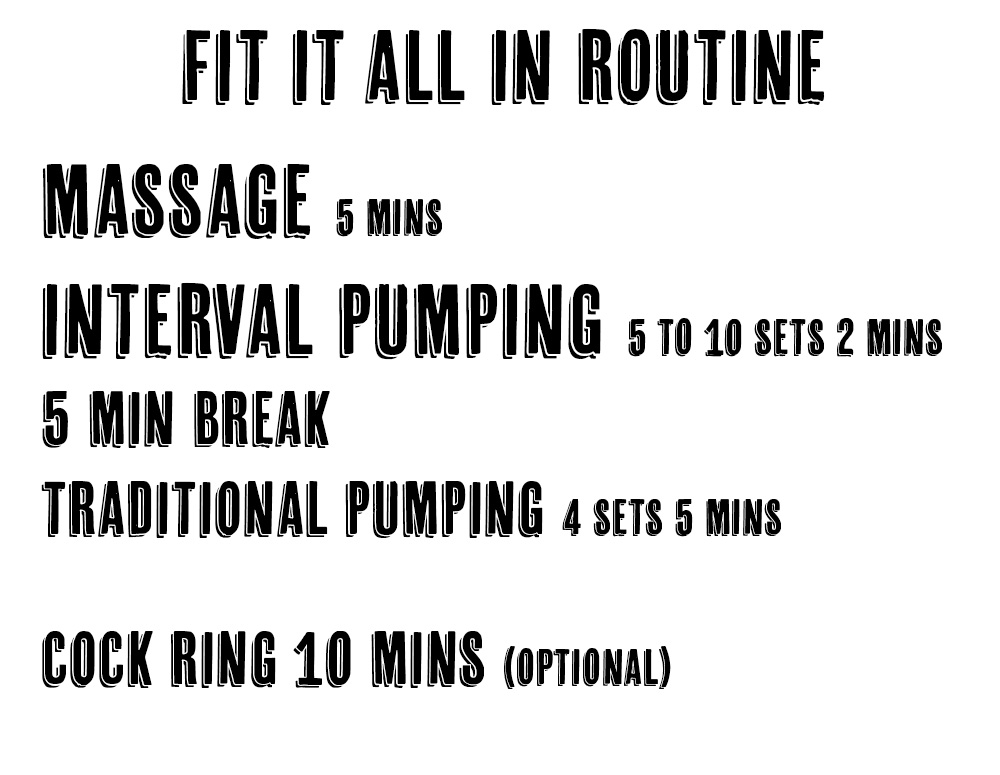
Advanced Combined Routine
This is closer to the full routine.
5 minutes massage
5–10 sets of 2-minute interval pumping
5 minute break
4 sets of 5-minute traditional pumping
Optional: 10 minutes cock ring wear
This is not something I would throw at a complete beginner.
You should already understand your pressure range, your edema response, and how your tissue feels the next day.
Final Thoughts
Pumping is simple, but it is not mindless.
Interval pumping and traditional pumping are different tools.
Interval pumping gives you repeated stretch and tissue fatigue.
Traditional pumping gives you longer dilation and more shape training.
The best girth routines usually use both, but not randomly. You want enough stimulus to create adaptation without turning every session into a recovery problem.
Start light. Track pressure. Watch edema. Pay attention to erection quality the next day.
Because the goal is not to win one pump session.
The goal is to build tissue that can actually hold more size long term.